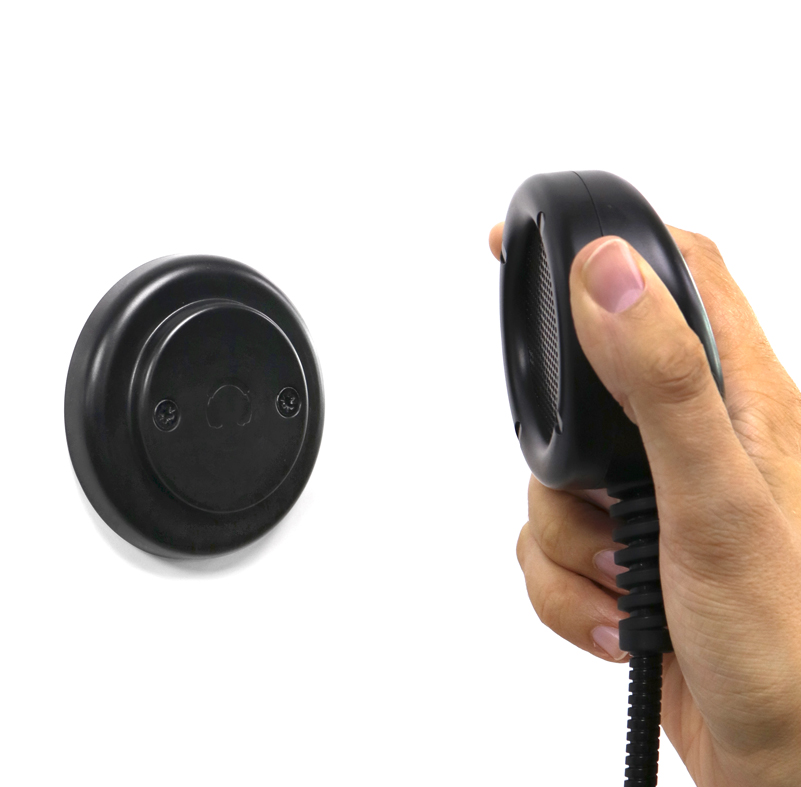
A handset is a component of a telephone that a user holds to the ear and mouth to receive audio through the receiver and speak to the remote party using the built-in transmitter. In earlier telephones, the transmitter was mounted directly on the telephone itself, which was attached to a wall at a convenient height or placed on a desk or table. Until the advent of the cordless telephone, the handset was usually wired to the base unit, typically by a flexible tinsel wire cord.
The handset of a cordless telephone contains a radio transceiver which relays communication via a base station that is wired to the telephone line. A mobile phone does not require a base station and communicates directly with a cell site in designated frequency bands.
Handset symbol
A graphic symbol that designates a handset is used on cordless and mobile phones to specify placing or ending a telephone call. Usually a button with green upright (off-hook) handset icon is used for starting a call, and a red lying-down (on-hook) handset is used for ending a call. Unicode has the handset symbol U 1F4DE 📞 TELEPHONE RECEIVER commonly faced rightwards to use with face emojis, and also symbols with specified direction: U 1F57B 🕻 LEFT HAND TELEPHONE RECEIVER, and U 1F57D 🕽 RIGHT HAND TELEPHONE RECEIVER.
See also
- Headset (audio)
- PopSocket
- Western Electric hand telephone sets
References
- Sajal K. Das (April 2010). Mobile Handset Design. John Wiley & Sons. ISBN 978-0-470-82467-2.