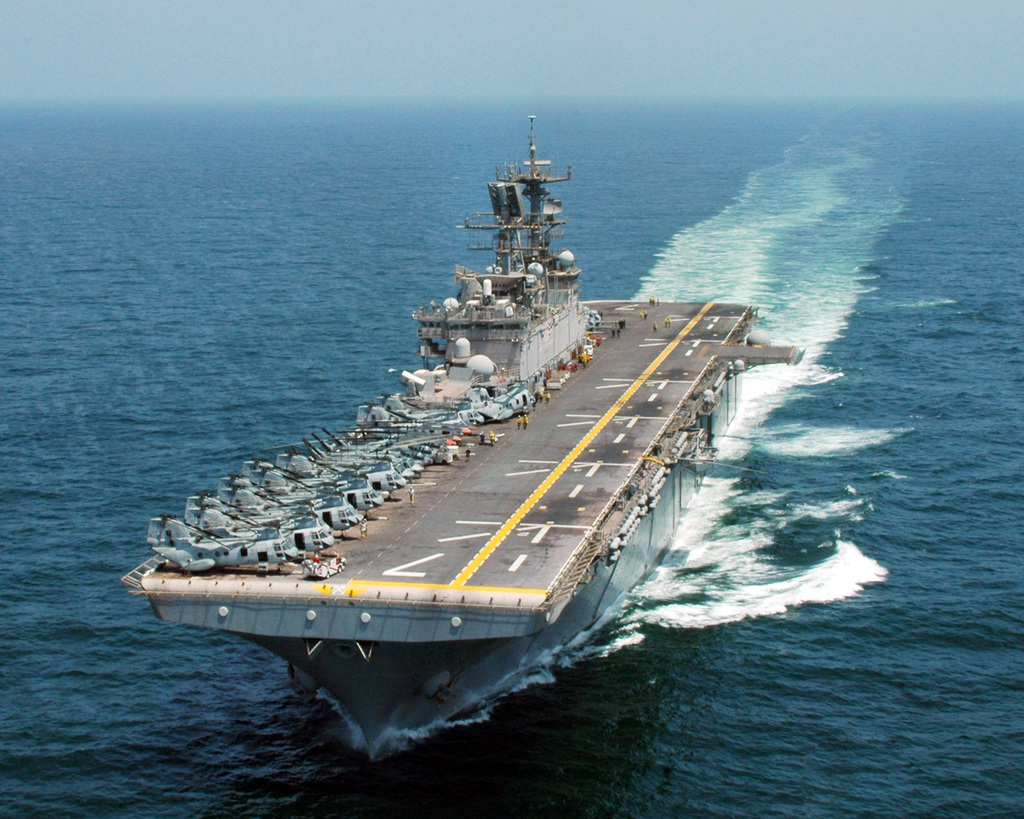
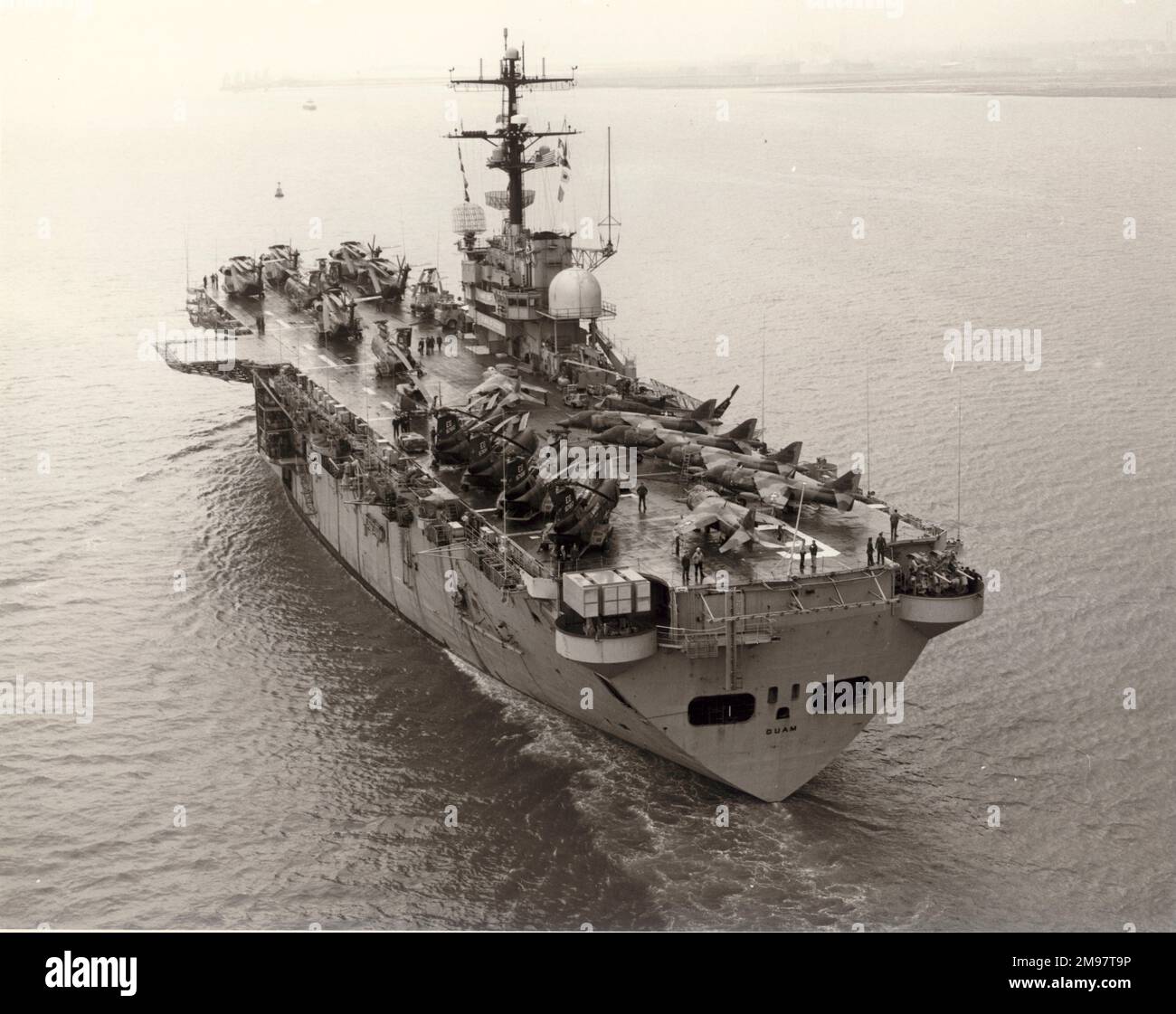
The Iwo Jima-class amphibious assault ships of the United States Navy were the first amphibious assault ships designed and built as dedicated helicopter carriers, capable of operating up to 20 helicopters to carry up to 1,800 marines ashore. They were named for battles featuring the United States Marine Corps, starting with the Battle of Iwo Jima. The first ship of the class was commissioned in 1961, and the last was decommissioned in 2002. The hull classification of "LPH" stands for "Landing Platform Helicopter".
Operational History
Ships of this class participated in several conflicts and peacekeeping and humanitarian relief operations:
- Nuclear weapons test support, Johnston Atoll 1962
- Cuban Missile Crisis 1962
- Vietnam War 1963–1973
- Dominican Civil War 1965
- Gemini and Apollo spacecraft recovery 1966–1975
- Iran hostage crisis 1980
- Multinational Force in Lebanon, 1982–1983
- Operation Urgent Fury, Grenada, 1983
- Operation Earnest Will, Persian Gulf 1987–1988
- Operation Sharp Edge, Liberia, 1990
- Gulf War 1990–1991
- Operation Eastern Exit, Somalia, 1991
- Operation Restore Hope, Somalia, 1993
- Operation Continue Hope, Somalia, 1994
- Operation Deny Flight, Bosnia, 1994
- Operation Uphold Democracy, Haiti, 1994
- Operation Vigilant Warrior, Kuwait, 1994
- Operation Assured Response, Liberia, 1996
One ship of this class, USS Guam (LPH-9), was used in a 1970-1974 Sea Control Ship experiment to test the concept of a smaller aircraft carrier using V/STOL aircraft.
Another ship, USS Inchon (LPH-12), was converted to a mine countermeasures ship which hosted mine sweeping helicopters.
The hull design of the Iwo Jima-class also became the basis of the slightly larger Blue Ridge class of amphibious command ships.
Ships In Class
The seven ships of the Iwo Jima-class were given non-sequential hull numbers, as, at the time of their construction, five existing aircraft carriers were being converted to serve in the Landing Platform Helicopter role - these five ships were renumbered, with the new ships slotted into a single sequence. The five existing ships were:
Popular Culture
One of the Iwo Jima-class ships served as the fieldsite in Edwin Hutchins's classic cognitive science study Cognition in the Wild. Although Hutchins does not mention the ship class by name, on p. 7 he characterizes it as a 603-foot-long (184 m) amphibious helicopter carrier.
References
- hazegray.org: Iwo Jima-class amphibious assault ships