Kepler-56 is a red giant in constellation Cygnus roughly 3,030 light-years (930 pc) away with slightly more mass than the Sun.
Characteristics
Kepler-56 is a red giant star. This means it is no longer fusing hydrogen in its core and is off the main sequence. Its mass is around 1.3 M⊙. Its radius is about 4.2 R⊙, putting the star's density at about 0.025 g/cm3. For reference, the Sun's density is about 1.408 g/cm3. Its metallicity is about 0.0251 Z0/X0. Its luminosity is about 9.6 L⊙, and its effective temperature is 4,973 K (4,700 °C; 8,492 °F), classifying Kepler-56 as spectral class K3III.
Kepler-56 is about 3.9 billion years old, placing it as about 600 million years younger than our Sun. Its apparent magnitude is 13, making it too dim to be visible to the naked eye.
Planetary system
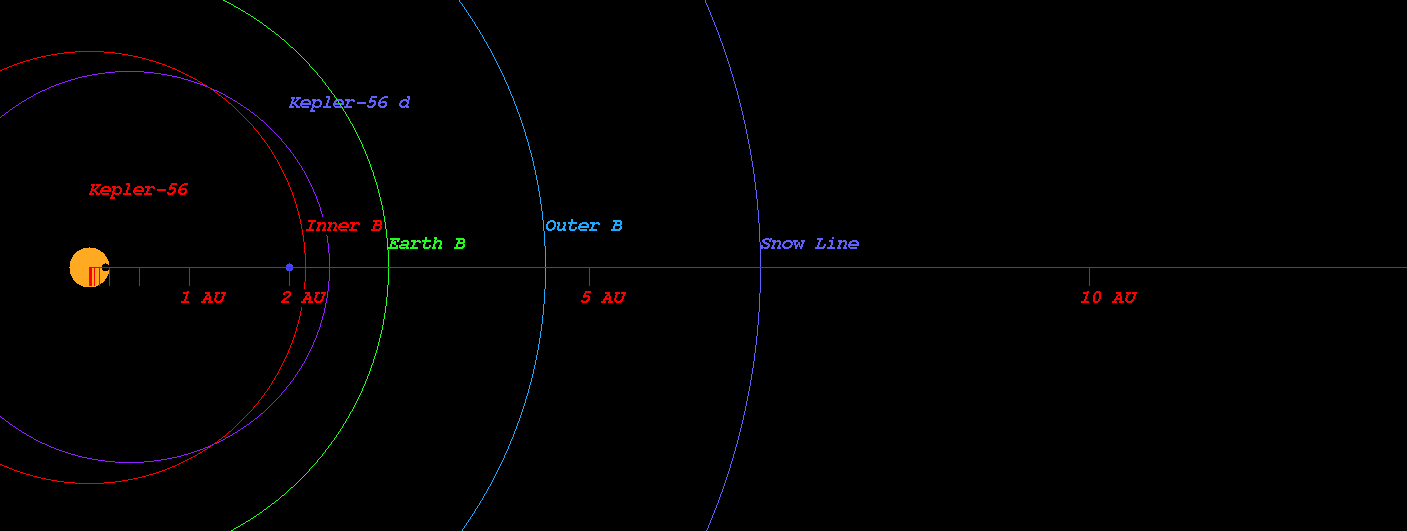
In 2012, scientists discovered a two-planet planetary system around Kepler-56 via the transit method. Asteroseismological studies revealed that the orbits of Kepler-56b and Kepler-56c are coplanar but about 45° misaligned to the host star's equator. In addition, follow-up radial velocity measurements showed evidence of a gravitational perturbator. It was confirmed in 2016 the perturbations are caused by third, non-transiting planet: Kepler-56d.
The planetary system is very compact but is dynamically stable.
Kepler-56 is expanding. As a result, it will devour Kepler-56b and Kepler-56c in 130 and 155 million years, respectively. 56d will be far enough to survive its parent star's red giant phase.
References
External links
- Kepler-56, The Open Exoplanet Catalogue
- Kepler 56, Exoplanet.eu