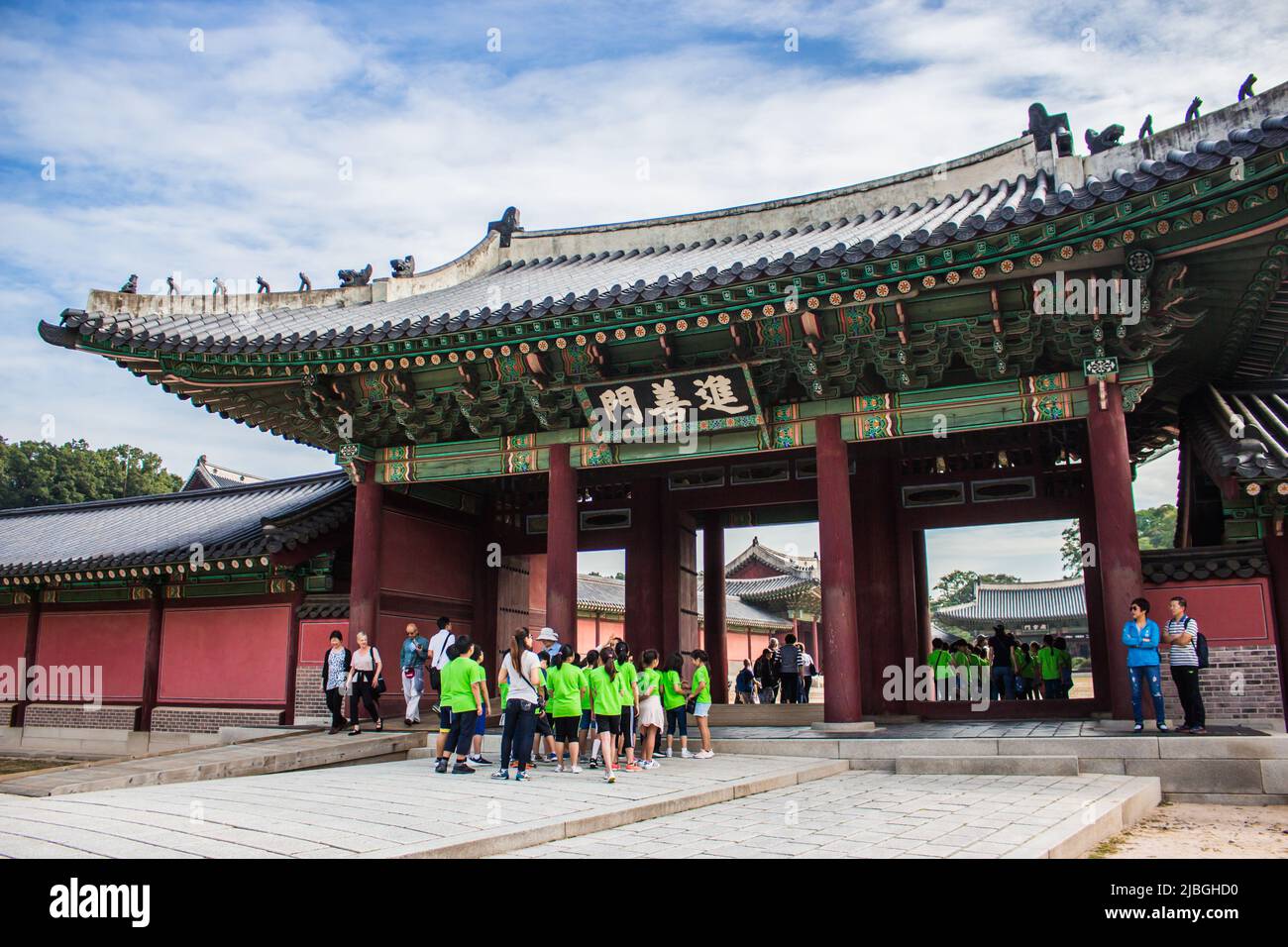
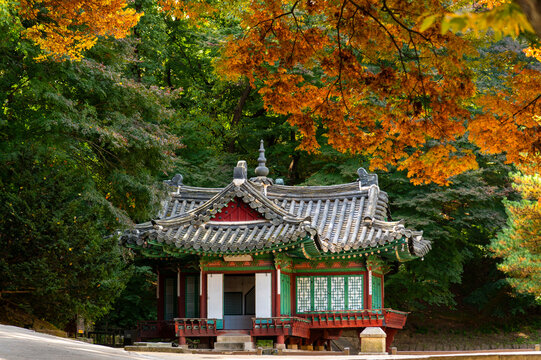
Changdeokgung (Korean: 창덕궁; Hanja: 昌德宮), also known as Changdeokgung Palace or Changdeok Palace, is set within a large park in Jongno District, Seoul, South Korea. It is one of the "Five Grand Palaces" built by the kings of the Joseon dynasty (1392–1897).
Changdeokgung was the most favored palace of many Joseon kings and retained many elements dating from the Three Kingdoms of Korea period that were not incorporated in the more contemporary Gyeongbokgung. One such element is the fact that the buildings of Changdeokgung blend with the natural topography of the site instead of imposing themselves upon it. Like the other Five Grand Palaces in Seoul, it was heavily damaged during the Japanese occupation of Korea (1910–1945). Currently, only about 30% of the pre-Japanese structures of the East Palace Complex (Changdeokgung together with Changgyeonggung) survive.
Name
"Changdeokgung" means "Palace of Prospering Virtue". The palace received this name on the 25th day, 10th month of 1404, shortly after the first phase of its construction was completed.
Changdeokgung and its neighboring palace Changgyeonggung are together known as the "Eastern Palace" (동궐; 東闕), as they are located to the east of the city's main palace Gyeongbokgung.
History
Establishment
In 1392 (Korean calendar), Joseon was established. Afterwards, the state's capital Hanyang (also called Hanseong and later called Seoul) was established and Gyeongbokgung was made its main palace (법궁; 法宮; pŏpkung). Due to political turmoil, the capital was temporarily moved to Kaesong and then back to Hanyang in 1404. King Taejong (r. 1400–1418) then ordered the establishment of Changdeokgung as a secondary palace (이궁; 離宮; igung). His possible motivations for this order have been analyzed. A number of scholars have argued Taejong wanted to avoid Gyeongbokgung because he associated it with unpleasant memories of familial deaths there and thought it had inauspicious feng shui qualities. Historians Lee et al. have also argued that he wanted a secondary palace to be freer from the political influences of government offices and politicians in and around Gyeongbokgung.
A temporary office was established to manage the creation of the palace. Changdeokgung's location was finalized on the 6th day, 10th month of 1404, and construction began that day. Under the supervision of Yi Chik, numerous artisans, soldiers, monks, and commoners worked on the construction. The first phase of construction was completed on the 19th day, 10th month of 1405. Taejong entered the palace on the 20th day of that month and held a celebration banquet there. At the time, there were only several complete buildings in the palace, including the royal bedchambers and bathhouse. The palace then had either a total of 287 rooms (칸; kan; k'an) or 192 rooms. There was likely not much space for government offices in the palace for government offices at the time; offices in and around Gyeongbokgung were repaired and officials likely went back and forth between those and Changdeokgung. Meanwhile, construction continued. In 1406, the shrine Insojeon (인소전; 仁昭殿; Insojŏn) and a Buddhist shrine were completed in the rear garden area, along with the pavilion Gwangyeollu (광연루; 廣延樓; Kwangyŏllu); in 1408, a pond was dug; and in 1411, a pavilion was completed.
Before the Imjin War
For the rest of his reign, Taejong primarily resided in Changdeokgung. Gyeongbokgung's restoration was ordered only after Taejong had moved into Changdeokgung. Even after his abdication, he resided in the palace Suganggung (수강궁; 壽康宮; later became Changgyeonggung) next to Changdeokgung; from there he influenced the reign of his son Sejong the Great (r. 1418–1450). Even after Taejong's abdication, construction continued. Part of a building collapsed and the supervisor of that building's construction was exiled as punishment. By 1418, facilities were deemed adequate enough to hold more significant ceremonies at Changdeokgung instead of at Gyeongbokgung. From the third year of Sejong's reign, Sejong began putting more emphasis on Gyeongbokgung and moved frequently between the two palaces. In 1426, he ordered that many structures in Changdeokgung be named. In 1427, he entirely moved out of Changdeokgung and resided primarily in Gyeongbokgung, although he continued moving between the two frequently. King Sejo (r. 1455–1468) significantly expanded Changdeokgung to the north and east. For one such project, 19,000 people from the Hanyang region were assembled. King Seongjo (r. 1469–1495) also expanded the palace and resided in Changdeokgung for the entirety of his reign. In 1475, he had all 29 of the palace's gates named and held a ceremony for the installation of their name plaques. As there was not enough space in Changdeokgung for all the living queens in the royal family, he decided to expand Changgyeonggung for them instead. King Yeonsangun (r. 1495–1506) also greatly renovated the palace, although renovations were put to a halt when he was deposed.
Destruction and reconstruction
In 1592, during the 1592–1598 Imjin War, all the city's palaces were completely burned down. It is debated who burned down the palaces, as surviving contemporary records are from intellectuals who did not witness the burnings. Various contemporary Korean texts, including the Veritable Records of Seonjo, report hearsay that it was Korean commoners who burned down the palace to destroy palace records. When the Japanese invaders entered the city on the 2nd day, 5th month of that year, Gyeongbokgung was still in tact. Japanese discipline in the city was reportedly initially high, but when they began suffering defeats, they took their frustrations out on the city and locals, burning buildings and killing.
After the war, efforts began to repair the city's palaces. Initially, plans were drawn up to have Gyeongbokgung repaired, but these were not acted upon. There is a record of arguments against Gyeongbokgung's reconstruction because of perceived inauspicious qualities of that palace. In addition, Joseon's economy had been devastated by the war, and funding for repairing Gyeongbokgung was likely difficult to procure. Changdeokgung was restored instead; a number of buildings were recreated in their original locations. The first round of restorations was completed during the reign of King Gwanghaegun (r. 1608–1623) on the 1st day, 9th month of 1610. However, Gwanghaegun expressed little interest in Changdeokgung, and continued to reside in the temporary palace Gyeongungung (later became Deoksugung). In 1617, he had the palaces In'gyŏnggung and Kyŏngdŏkkung established.
In 1623, during the Injo coup that installed King Injo (r. 1623–1649), rebels burned down almost all the buildings in Changdeokgung. Only Injeongjeon, two buildings for the Owi, a palace pharmacy, a building for the government office Ch'unch'ugwan, a building called Biseunggak, a building for the government office Hongmun'gwan, and a building called Sujeongjeon were spared. Injo was crowned at Gyeongbokgung, and resided at Changgyeonggung. He had In'gyŏnggung and Kyŏngdŏkkung demolished and recycled to repair Changdeokgung and Changgyeonggung. Injo had the rear gardens renovated, and spent much relaxation time there. In 1624, during Yi Kwal's Rebellion, Changgyeonggung was mostly burned down. Injo then resided in Kyŏngdŏkkung temporarily, and first ordered that Changgyeonggung be repaired. In 1633, after repairs on Changgyeonggung were completed, Injo ordered that Changdeokgung be repaired. He then began to temporarily reside in the palace pharmacy. Construction work on palaces was interrupted and delayed by the 1636 Qing invasion of Joseon. Minor construction projects occurred in the meantime, especially in the rear garden. Significant construction resumed in 1647 and concluded after five months in 1648; a significant reason for why construction was able to be finished in five months was because of recycling of buildings from In'gyŏnggung. In total there were around 735 rooms in the palace around this time. One significant change after the reconstruction was the presence of more government office buildings. This was in part because the government offices in Gyeongbokgung had not been restored.
After this reconstruction and without rivalry from Gyeongbokgung, Changdeokgung firmly became the main palace of Joseon. More buildings continued to be constructed in the palace. There was a fire in the palace in 1671. Under the reign of King Sukjong (r. 1674–1720), the rear garden reached its greatest extent. In 1687, a fire destroyed almost all of the Mansujeon area. In 1702, a fire destroyed part of the East Palace. Succeeding kings continued to expand and renovate the palace, although King Yeongjo (r. 1724–1776) ordered much fewer repairs as he primarily resided in Gyeonghuigung. There were a number of fires during the reign of King Sunjo (r. 1800–1834), with one major one occurring in the 10th month of 1833. During his reign, most construction at the palace was either rebuilding or maintenance work. By the 19th century, Changdeokgung and Changgyeonggung were functionally a single palace. The two had some unique government officies, although they had some facilities with overlapping purposes.
Late Joseon and Korean Empire periods
In 1865, efforts began to restore Gyeongbokgung. King Gojong (r. 1864–1907) and his family moved out of Changdeokgung and into Gyeongbokgung on the 2nd day, 7th month of 1868. Although Gyeongbokgung was officially made Joseon's main palace, Changdeokgung continued to see some use. Gyeongbokgung experienced major fires in 1873 and 1876. After the 1876 fire, the royal family moved back into Changdeokgung and did not return to Gyeongbokgung until 1885, after the 1884 Kapsin Coup. He would reside mostly in Gyeongbokgung until 1895. Meanwhile, more maintenance work occurred at Changdeokgung. Such work was interrupted in by the 1882 Imo Incident. In 1891, a number of Changdeokgung's buildings were disassembled and moved to Gyeongbokgung.
Amidst increasing Japanese influence over Korea and the 1895 assassination of Empress Myeongseong at Gyeongbokgung, Gojong fled Gyeongbokgung and made Gyeongungung his official palace. From there, he established the Korean Empire and crowned himself emperor. Gojong did not significantly use Changdeokgung thereafter. Some minor construction work continued at the palace in his absence.
In 1905, Korea was made a protectorate of Japan, governed by the Japanese Residency-General of Korea. On July 19, 1907, Gojong was forcefully deposed by Japan and replaced by his son and the final Korean monarch Emperor Sunjong (r. 1907–1910). After ascending the throne, Changdeokgung was made Sunjong's primary residence, while Gojong continued to stay in Deoksugung. Historian Lee Gyu-cheol argued that Japan moved Sunjong to Changdeokgung in order to separate him from his father. Soon after his coronation, Sunjong ordered that Changdeokgung be repaired. He moved in to the palace in November of that year. The residency-general oversaw the demolition of large portions of the palace from 1907 to 1909; this has since been viewed critically by Lee et al., who argued it was an attempt to demolish a symbol of Korean sovereignty.
Colonial period
On August 29, 1910, Japan colonized Korea. According to a 1912 document, the Office of the Yi Dynasty, an organization representing the former Korean royal family, owned the palace. Japan continued significantly altering the palace, demolishing dozens of buildings. Despite this, the overall outer boundary of the palace and its rear garden remained mostly unchanged throughout the colonial period.
Around 5 p.m. on November 10, 1917, a major fire broke out in the palace. It began in the former emperor's bedchambers Daejojeon and destroyed the naejŏn area of the palace. It was extinguished by 8 p.m. that day. Numerous valuables and historic relics were lost in the fire. Reconstruction work began soon after and lasted for years afterwards, although it was delayed by the 1919 March First Movement protests. The colonial government ordered that many of Gyeongbokgung's buildings be demolished and recycled for reconstructing Changdeokgung. Daejojeon was reconstructed by 1920, and the former royal family resumed living in it.
Sunjong died in the palace on April 25, 1926. Historian Se-Mi Oh argued that, after Sunjong's death, efforts to modify the palace accelerated. In either 1927 or 1931, the road Yulgok-ro was constructed between Jongmyo and Changdeokgung, separating the two entities for the first time. Oh described the separation as "direct violence against the sacred ancestral shrine and the monarchy".
Post-liberation
Parts of the palace (notably Nakseon-jae hall) continued to function as a royal residence up to 1989, when both Princess Deokhye and Crown Princess Bangja died. Other post-WWII residents included Empress Sunjeong (Sunjong's second wife), Crown Prince Yi Un, his son Yi Gu and Yi Gu's wife Julia Mullock. Residence for former royals in the palace in the post-war period was at the whim of the South Korean presidents, and after the Korean liberation in 1945 it would take the resignation of Rhee Syngman for former imperial family members to be allowed back in.
Changdeokgung was added to the UNESCO World Heritage List in 1997. The UNESCO committee stated the place was an "outstanding example of Far Eastern palace architecture and garden design" being exceptional because the buildings are "integrated into and harmonized with the natural setting" and adapted "to the topography and retaining indigenous tree cover."
Design and layout
The palace was designed in consideration of both ancient Chinese principles and practicality. Changdeokgung's primary layout is based on the three gates and three courtyards (삼문삼조; 三門三朝; sammunsamjo) system, from the Chinese work Kaogongji, part of the Rites of Zhou. The system advocates for palaces to have three main sections that are to be accessed in sequential order. The sections proceed from public-facing to private. These sections are the first gate Donhwamun and courtyard (외조; 外朝; oejo; used for government offices and public-facing events), second gate Jinseonmun and courtyard (치조; 治朝; ch'ijo; used for conducting politics between the king and his subjects), and third gate Injeongmun and courtyard (연조; 燕朝; yŏnjo; where the king and his family resided).
Lee et al. subdivided the palace as such: oejŏn, naejŏn, East Palace, government offices, and rear gardens (also called Secret Garden).
Changdeokgung is based primarily on a west to east axis, in contrast to Gyeongbokgung's south to north axis. Correspondingly, the outer palace proceeds east to the inner palace.
There are numerous mulberry trees around the palace, the leaves of which can be used to feed silkworms. This is possibly linked to several queens having raised silkworms in the palace.
Relationship with Changgyeonggung
Changdeokgung and Changgyeonggung have been strongly interlinked, and have been described as functionally being a single palace. Buildings for which there was insufficient space in Changdeokgung were often constructed in Changgyeonggung instead. Changdeokgung and Changgyeonggung are separated by the gate Geonyangmun (건양문; 建陽門; Kŏnyangmun). Over time, various contradicting claims have been made about which buildings (particularly those on the border of the two palaces) belonged to which palace. Such claims were made about the East Palace, Junghuidang, and Changgyeonggung's Jeoseungjeon (저승전; 儲承殿; Chŏsŭngjŏn).
According to a 1912 document, the two palaces were then considered to belong to the same administrative district: Waryong-dong. The two palaces were physically divided with a border wall during the colonial period. In 1963, the border wall was used to define a formal legal boundary between the two palaces. This boundary has persisted to the present.
Landmarks
Outer gates
Oejo
Oejo (외조; 外朝) refers to a part of a palace where the king conducts state affairs. It can be subdivided into the chŏngjŏn (정전; 正殿; jeongjeon; main area) and p'yŏnjŏn (편전; 便殿; pyeonjeon; secondary area).
Oejŏn
Government offices
The government offices inside palaces are called kwŏllaegaksa (궐내각사; 闕內各司; gwollaegaksa). Changdeokgung's facilities were relatively small and meant for daily work with the king; most large government ministry facilities were located outside the palace, for example on Yukcho Street. After being destroyed in 1592 during the Imjin War, government offices were rebuilt during in 1647. Many offices that had once existed in Gyeongbokgung were moved over to Changdeokgung. All government office buildings in front of Seonjeongjeon and Huijeongdang were demolished between 1907 and 1909.
Naejo
Naejŏn
Naejŏn (내전; 內殿; naejeon) refers to a part of a palace where a king or queen resided. Palace women, particularly those of the Naemyŏngbu, also often used this space. When space for buildings became insufficient in this part of the palace, buildings were constructed in Changgyeonggung instead. The naejŏn experienced a fire in 1833 and was rebuilt in 1834. It was completely destroyed in the 1917 fire.
East Palace
The East Palace (동궁; 東宮; Donggung; Tonggung) was used as the residence, study area, and office of the crown prince, although when it was not occupied by a crown prince it was used for other purposes. Before the Imjin War, it was located outside the confines of Changdeokgung. It was reconstructed after the Imjin War, but after a series of fires, it was reconstructed closer to the rest of the palace, as part of the naejo. Its facilities became shared by both Changdeokgung and Changgyeonggung, and its main gates are located to the east, meaning that it was primarily meant to be accessed from Changgyeonggung. After Gyeongbokgung and that palace's East Palace was reconstructed in the late 19th century, Changdeokgung's East Palace lost its utility. Many of the buildings in this area no longer exist.
Secret Garden
The rear garden (후원; 後苑; Huwon; Huwŏn), popularly known as the Secret Garden (비원; 秘院; Biwon; Piwŏn), is located to the north and rear of both Changdeokgung and Changgyeong, and access to it is shared by both palaces. It was a private garden used often for leisure, but also for politics, ceremonies, military training drills, and civil service and military examinations. Leisure activities included hunting, parties, and practicing martial arts. Prior to the 20th century, entrance into the garden was prohibited for most people. A new road was built in the area in 1909. It has a number of artificial ponds and pavilions. It has over 160 species of trees. More than 70 trees in this area are over 300 years old. The garden's highest elevation is in its center, and it slopes to the east and west.
Buyongjeong area
Yeongyeongdang area
Ongnyucheon area
The stream Ongnyucheon (옥류천; 玉流川; lit. Jade Stream) flows through the north side of the Secret Garden. It was created in 1636. This area was closed for access beginning in 1979, in order to protect the ecology of the area. It was reopened to the public on May 1, 2004 on a reservation only basis. The pavilions Soyojeong, Taegeukjeong, and Cheonguijeong are collectively called the "Three Pavilions of the Royal Grove" (상림삼정; 上林三亭) and have been described as scenic.
Aeryeonjeong area
Gwallamjeong area
Other structures
Nakseonjae area
Old Seonwonjeon area
New Seonwonjeon area
Other
Geumcheon and Geumcheongyo
Geumcheon (금천; 錦川; lit. silky water) is the kŭmch'ŏn (금천; 禁川; different Hanja but same Hangul spelling) that previously flowed through the palace. Water no longer flows through the stream.
The Changdeokgung Geumcheongyo (창덕궁 금천교; 昌德宮 錦川橋) is a kŭmch'ŏn'gyo (bridge over a kŭmch'ŏn) that crosses over Geumcheon. It was completed on the 18th day, 3rd month of 1411 and is the oldest extant kŭmch'ŏn'gyŏ of all Joseon palaces. It has two arches. It has a number of stone statues of mythological creatures. On its northern baluster is a statue of the Black Turtle-Snake, mythological guardian of the north. The statue on the south baluster is the Bai Ze, guardian of the south. On each of the bridge's four newels is a statue of a Xiezhi. The bridge also has engravings of a dokkaebi (Korean goblin) called nati on both sides.
Notes
References
Sources
In Korean
- 경복궁 변천사 (上) (in Korean). Cultural Heritage Administration. August 2007.
- 이강근. "창건이후의 변천과정 고찰". In Cultural Heritage Administration (2007).
- 이규철. "고종 중건과 대한제국 말기까지의 변화 고찰". In Cultural Heritage Administration (2007).
- 신혜원 (2007a). "일제시대의 변화 고찰". In Cultural Heritage Administration (2007).
- 신혜원 (2007b). "1945년 이후의 경복궁". In Cultural Heritage Administration (2007).
- 조선시대 궁궐 용어해설 [Glossary of Joseon-era Palaces] (in Korean). Korea Heritage Service. 2009-12-07. ISBN 978-89-6325-247-6.
- 창덕궁 육백년 (in Korean). Cultural Heritage Administration Changdeokgung Palace Management Office. 2005-11-20. ISBN 9788981245290.
- 창덕궁 해설문 (in Korean). Cultural Heritage Administration Changdeokgung Palace Management Office. 2007-12-04.
- 박명호; 김현정; 최동녕, eds. (2022-11-14). 서울 역사 답사기 6: 종묘사직, 궁궐, 성균관 (in Korean). Seoul: Seoul Historiography Institute. ISBN 979-11-6071-148-6.
- 김지영. "걷다보면 마주치는 선정의 흔적들". In Seoul Historiography Institute (2022).
- 김웅호. "조선왕조를 대표하는 공간". In Seoul Historiography Institute (2022).
- 이강근; 이혜원; 이경미; 안병찬 (August 2011). 조선왕실의 건축, 창덕궁 학술연구 (in Korean). National Palace Museum of Korea – via Korea Heritage Service.
- Chang, Pil-Gu; Jeon, Bong-Hee (December 2013). 고종 장례 기간 신선원전의 조성과 덕수궁·창덕궁 궁역의 변화 [Construction of Sin-Seonwonjeon Shrine and Transformation of Deoksoogung and Changdeokgung Palaces' Area During King Kojong's Funeral]. Journal of the Architectural Institute of Korea – Planning & Design (in Korean). 29 (12): 197–208. ISSN 1226-9093 – via DBpia.
In English
- Yi, Hyang-woo (2015-01-30). Na, Gak-sun; Mark, Patton (eds.). Korean Royal Palace: Changdeokgung. Translated by Won, Hyeon-suk; Yi, Choonsun. 인문산책. ISBN 978-89-98259-06-8.
External links
- Media related to Changdeokgung at Wikimedia Commons
- Official website
- UNESCO: Changdeokgung Palace Complex